What might it “look like” to “achieve sustainability”?
It seems to me that this desirable process wouldn’t occur as a “monolithic”, simultaneous, homogenous, all-encompassing global or societal movement, but rather as the converging transitions of many, many different individual systems and sub-systems. These could be, for example, a city’s mobility system, a region’s water system, a country’s food system, or the international system for costing and limiting carbon emissions. Transition might happen across different scales of space and time, and many different specific contexts.
We can then ask: what are the “drivers” of transition in a particular system or context? An interesting 2018 paper by systems scientists from Europe and the USA synthesising more than 20 years of research in the field provides intriguing insights.
The researchers used a qualitative and quantitative “meta-analysis” to study several well-established and evolving theories and frameworks of systems change. They integrated key concepts from the “Multi-level Perspective” (MLP), which we have looked at previously, as well as “Strategic Niche Management” (SNM), Transition Management (TM) and “Technological Innovation Systems” (TIS).
The MLP, as we have discussed, is a theory that explains how radical innovation emerges from “niches” and starts to take hold in deeply entrenched systems (or “regimes”) that have been “dislodged” or disturbed by “landscape” events outside the control of regime actors. SNM is a convergent approach that seeks to systematically establish, protect and eventually de-construct “niches” with accompanying real-life “experiments” facilitating the “co-evolution” of sustainable new technologies into socio-technical systems. TIS seeks to understand the emergence and diffusion of innovation through consideration of broader actor and institutional networks and the systemic functions and dynamics of these. TM is a form of “adaptive, reflexive governance” that provides answers to the question: “how do we come together to form and steer a sustainability transition?”.
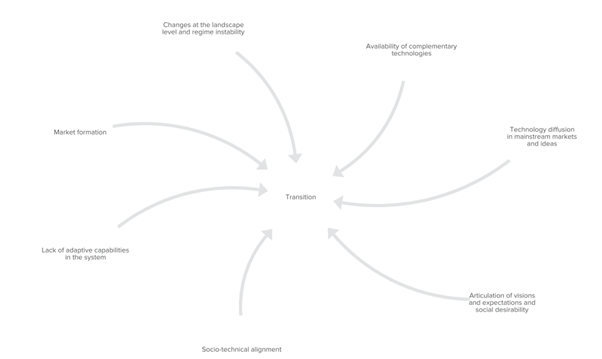
The researchers synthesised concepts from these different theories using a rigorous “integrative” approach to develop quite a complex (!) overall map of systems change theory – which you can find here. A very interesting part of this map is the “transition” node and its “drivers” – displayed in the above figure.
These are the somewhat interlinked factors that accelerate transitions to sustainability in particular systems. One might also try to think of them in relation to the “leverage points” for change conceptualised by Donella Meadows, the great systems scientist. (Caveat that not all of these factors might be immediately and explicitly available as “handles” for practitioners.)
We have previously seen that “changes at the landscape level” which are “outside the control” of the particular regime (system) can create “windows of opportunity” for more sustainable technologies to take hold. For example, if Europe implements a carbon tax on imports, it can affect exports from developing countries, disrupting regimes there and potentially accelerating their transitions to sustainability.
The next interesting driver is “lack of adaptive capacities in the system”. This represents the case where a regime lacks the ability to “adapt” to stressors and change ensuing from sustainability and climate change issues. For example, a large industry manufacturing consumer goods may face a plethora of business risks – financial, strategic, operational, regulatory and reputational – from water related factors. It may proactively seek to locate, trial and integrate emerging water efficiency solutions, especially when key “adaptive capacities” – for example, entrepreneurial grit, research and development skills and risk capital – don’t exist within the regime.
Many such emerging solutions will require support in order to achieve their full potential. This is because, while they may increase sustainability of a particular system or process, they might need time to “mature” and become cost-competitive in the open marketplace. This can be supported through policy that provides subsidies and minimum procurement quotas, for a specific duration of time. This promotes the development of “market niches” where technology and system can learn and “co-evolve” until there is a competitive fit driving transition. These niches can also sometimes form and evolve even without policy incentives, when there are other “benefits”, tangible and intangible, that the system sees in engaging with an emerging novelty.
Once the innovation starts to take hold, the magic stage of “upscaling” can (hopefully) occur, where technology “diffuses” from niches into the mainstream. This is aided by the presence of “complementary” technologies that help to co-create the new regime structure.
Solar photovoltaic (PV) cells are interesting to think of in terms of technology transition; their first market niches were dollar-bill changers and computer equipment in the 1950s, followed by space satellites as a primary application. In the 1970s, less costly cells were developed, and by 1982, the first megawatt-scale solar PV plant was installed. Solar PV’s success has certainly been accelerated by continuing subsidies and other financial incentives, especially in the modern landscape where the imperatives of a net-zero future increasingly pressure and destabilise legacy systems. Emerging and complementary innovations like electric vehicles and improved energy storage systems work synergistically to accelerate this transition.
The last two drivers, “articulation of visions & expectations and social desirability” and “socio-technical alignment” are fundamentally related, in my opinion, and very interesting to examine in the context of “systems” innovation. It’s clear to even hardcore capitalists that the free market won’t “self-correct” and that climate change is indeed “the greatest market failure” in history. On the other, hand, policy action alone is unlikely to correct our trajectory in time either – despite the Paris climate agreement, we are on track to reach record new temperatures over the next five years that could send the world into “uncharted territory”. So what tools do we use to steer systems change?
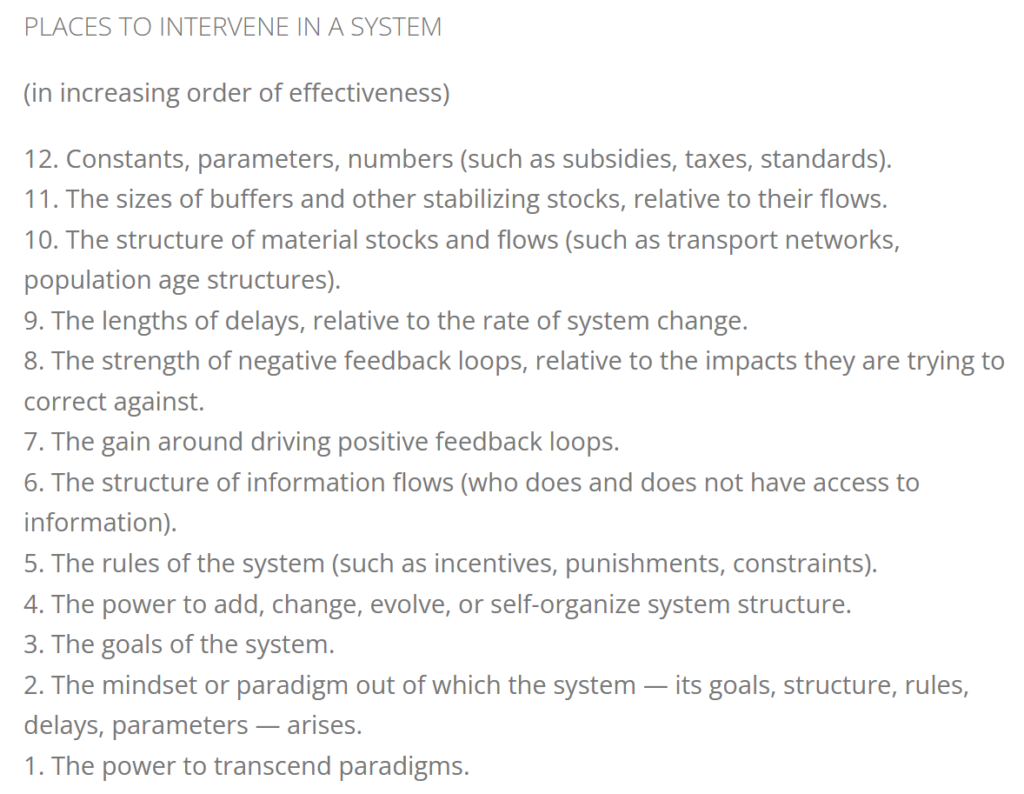
‘Articulation’ is a powerful driver of systems change. According to Donella Meadows, of all the “leverage points” in a system (Figure 2), the most powerful and effective are those that relate to and transcend the “mindset” or “paradigm” of the system (and its designers). And the weakest are “constants, parameters and numbers” – like the 1.5 degree Celsius Paris target.
The participatory co-creation and articulation of new narratives and sustainability visions has the power to change the minds, hearts and culture of people, institutions and society. This opens the possibility for the system to shift into a state of socio-technical “alignment” – overcoming the dreaded “policy resistance” which plagues even the most well-meaning efforts to create change.
In further articles we will look more closely at the “how” of facilitating alignment and transition, with examples from specific contexts. We will especially look to explore “transition arenas” – safe spaces where new, grounded narratives for transition can be collaboratively developed, deployed and tested by niche, regime and other actors working in close partnership with systems scientists.
Leave a Reply