In the previous article in this series on sustainability and systems change, we looked at the “drivers” of transition to sustainability, according to recent research. In this article, we will look at the question: how can we “govern” the transition to sustainability? In particular, we will look at an approach called “Transition Management” which, like so many developments in the field, has its origin in research and experimentation in the Netherlands.
Before we dive into the topic, it’s helpful to ask the question: what does it mean to “govern” something, anyway?
A “classic work” says that governance is:
“the totality of interactions, in which public as well as private actors participate, aimed at solving societal problems or creating societal opportunities; attending to the institutions as contexts for the governing interactions, and establishing a normative foundation for all those activities”.
That’s quite a mouthful! Is there a simpler way to look at the concept of governance?
It’s instructive to go back to the word root – the Greek kubernaein – which means “to steer”. We might think of governance as a steering process then, with society as a ship. How can the ship ‘steer’ itself to sustainability?
For fun, let’s imagine it’s a spaceship we are steering. Somehow, the societal spaceship has gone badly off-course in the galaxy Zog and is millions of light-years away from the intended and ‘normatively desirable’ destination – the planet ‘Sustainable Earth’ in Sector Zeta Three Plus.
To make things more challenging, to get to the destination, the spaceship has to navigate treacherous areas for which no maps have ever been made, and deal with obstacles such as interstellar black holes, raging solar winds, gravitational turbulence and unfriendly aliens. To make the voyage successfully, moreover, the spaceship needs new “systems”– new propulsion, new navigation and sensors, a new warp drive and new space shields. These systems have never been built before, although some think it’s possible. (You might think of these challenges as ‘squaring the circle’, to create a society that operates sustainably and within planetary boundaries through large scale transitions to clean energy, electric mobility, advanced water management, circularized production and consumption, etc. – before we run out of time.)
Faced with these challenges, the captain of the ship, who is ultimately ‘responsible’ for steering, decides to create an “arena” for the best and brightest minds in society to collaborate on this challenge. The objective of creating this “transition arena” is to collaboratively discuss these challenges, innovate new solutions and transition and scale them into the spaceship’s enormous legacy machinery.
Who should be in the arena? Well, definitely the existing systems operators. Why? Well because they will have good ideas regarding why and how the existing systems are working – or not working – for the intended voyage. Also, innovators and experimenters – people with new ideas, new technologies and new ways of doing things – people with entrepreneurial grit, who aren’t too afraid to fail in their attempts to develop new things of value to society, should definitely be part of the transition arena.
It’s interesting that these participants in the transition arena are considered “powerful”, according to research – but in different ways. The “regime” participants can “reproduce existing institutions” through their “reinforcive power”. And the innovators and entrepreneurs bring “innovative power” – something the regime doesn’t intrinsically possess (as we saw in the last article, lack of ‘adaptive capabilities’, including innovation, is a ‘driver’ for regimes to transition). This power allows innovators to create new resources that are in some sense “independent” of existing regime systems, and can therefore evade being “captured” by the existing political economy. For example, innovators can create new materials, new processes or new intellectual property, to solve certain problems in water, energy or circularity. Since these are created outside the existing regime, they are not the property of any industry or corporate.
Think for example of the electric vehicle (EV). “Who killed the electric car?”, a 2006 film, documented the attempts of gigantic corporations to stymie the policy-mandated production of zero-emission EVs in the United States. However, by 2023, the EV market was seeing “exponential growth”, with 14 percent of all new cars sold being in this category, according to the International Energy Agency. What changed? Many would argue that Tesla, a groundbreaking startup founded in 2003, almost single-handedly changed the story. It’s interesting that in 2014 Tesla applied the “open-source” philosophy to its “innovative power” – declaring “All Our Patent Are Belong To You” – because “it is impossible for Tesla [alone] to build electric cars fast enough to address the carbon crisis.”
When innovators and regime players do come together, they can create “transformative power” with potentially massive impact to transition entire systems. For example, the Indian government is in process of experimenting with “cutting-edge technologies”, such as Artificial Intelligence, to “create significant economic and societal impact”. These offer opportunities to come together to reconfigure and renew institutions and public digital infrastructure, to meet current and emerging socio-technical challenges in urban governance, healthcare, agriculture and other systems.
“Politics” has been described as “who gets what, when and how”. By this definition, the creation of the transition arenas and the socio-technical problem-solving process of transition management is certainly political. In the process of re-configuring the ship’s systems, there will inevitably be “winners” and “losers”. Some of operators of legacy systems might lose business. New markets and opportunities might also be created. Political “legitimation” is required (effectively from the captain of the ship) to take decisions in the best interests of societal ambitions for sustainability.
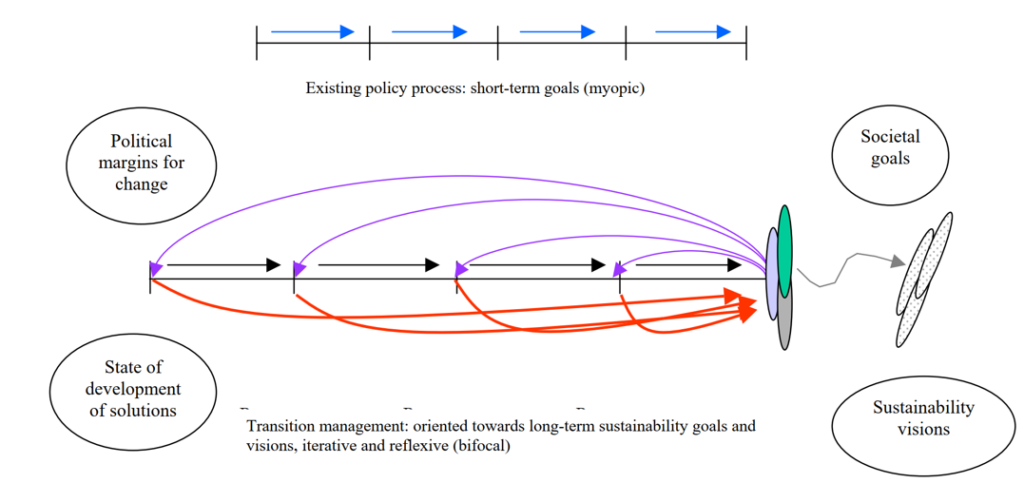
Figure 1 – Transition management is a “bifocal” process. From Kemp & Loorbach (2003)
However, this differs from “politics as usual”, which is usually concerned only with short-term goals. Transition management constantly references both near-term as well as far-term societal goals. The diagram above shows this approach (think of a pair of glasses with bifocal lenses). For these discussions to proceed fruitfully obviously requires serious political buy-in and legitimation of the long-term aspiration to become sustainable.
It’s very interesting that, apart from the “political” aspects, transition management needs another type of legitimation. This is where the “systems science” comes in. When so much is at stake, societal decision-making needs to be put on a firm and objective basis as far as possible. Scientists are needed to carefully design, oversee and measure the results of “experiments” in socio-technical innovation. They also play a critical role in predicting the long-term consequences of particular short-term goals, and helping choose the appropriate short-term goals given long-term objectives. This process of forward and backward extrapolation should be performed with the best available scientific advisory, in particular leveraging the appropriate computer models. For example, a particular policy for carbon pricing may have economic growth, socio-environmental, climate justice and other trade-offs whose dynamics might be fruitfully explored through appropriate modelling. To skilfully shape an appropriate policy of this kind would certainly require state-of-the-art methodology as practiced by the “knowledge makers” – the scientists.
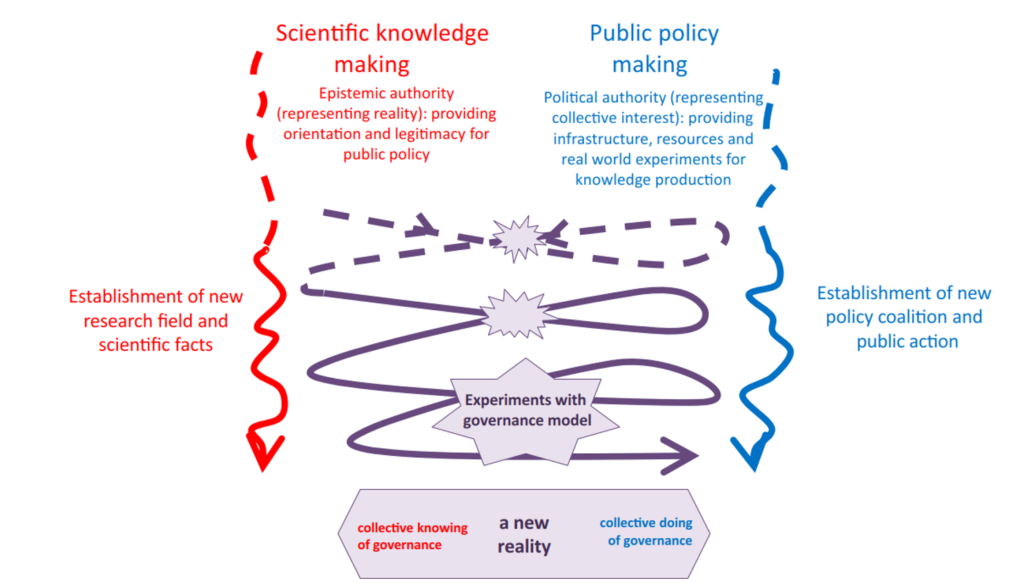
Figure 2-Governance in transition management is co-created by scientific and political authority. Source: Voss (2014)
When “epistemic” (or knowledge-creating) authority meets “political” authority, a unique form of experimental, adaptive governance is realized, as in the figure above. A legitimated, expertly facilitated transition arena, including participation of “front-runner” representatives from ‘across the system’ opens up the potential for massive societal change.
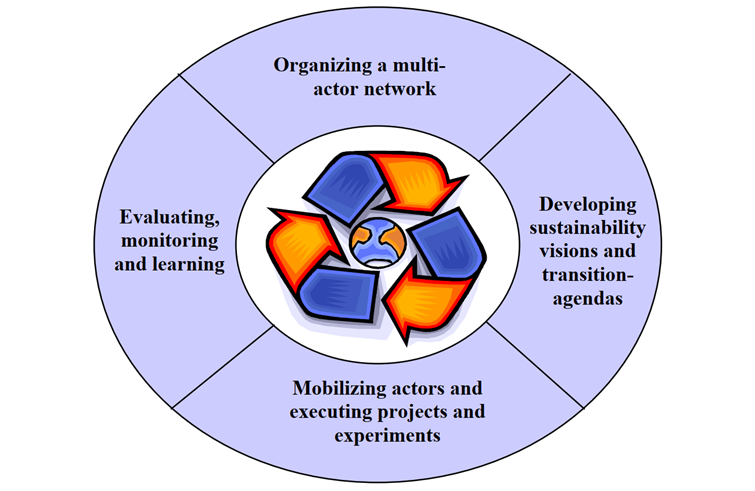
Figure 3-The iterative action-research process of transition management. Source: Kemp & Loorbach (2003)
In keeping with the “scientific”, open-ended spirit of transition management, this form of governance doesn’t follow the usual top-down “plan-and-implement” policy model that has proved ineffective for so many of the “wicked” challenges we face. It is based on following an iterative “process” (depicted above) that collaboratively determines desirable outcomes and “finds the way” towards these.
These ideas of “experimental, adaptive, complex-systems based governance” originated more than 20 years ago in the Netherlands, during the country’s fourth National Environmental Policy Plan, that introduced transition management as official government policy, and have been applied to healthcare, circular economy, decarbonization and many other applications.
It’s interesting that the Netherlands is considered one of the most open societies of the world, and a “Full Democracy” that ranks highly on metrics like the 2023 Economist Democracy Index. It would seem that participation, openness, free speech and rigorous scientific engagement into governance is required to truly transition systems onto trajectories to sustainability. For those of us living in the so-called “flawed democracies” of the Global South – where systems and institutions are constantly at risk of capture or dilution – the question is – how can we co-create and foster the culture of dialogue and openness required to truly transition? Will it require a new cycle of leadership? Do we have the time for that? Are you, dear reader, one of those next-generation leaders who can help us steer the spaceship to sustainability in time?
This article is part of a series on sustainability and systems change. Previous articles looked at The Drivers of Transition; the Multi-level Perspective and its evolutionary aspects; and systems science for “sustain-ability“.
I would love to hear your comments and thinking regarding the topics discussed!
Further reading:
Kemp, R., & Loorbach, D. (2003). Governance for Sustainability Through Transition Management.
Loorbach, D. (2007). Transition Management: New mode of governance for sustainable development
Loorbach, D., Frantzeskaki, N., & Huffenreuter, R. L. (2015). Transition Management: Taking Stock from Governance Experimentation. The Journal of Corporate Citizenship, 58, 48–66. https://www.jstor.org/stable/jcorpciti.58.48
Voß, J. P. (2014). Performative policy studies: Realizing “transition management.” Innovation: The European Journal of Social Science Research, 27(4), 317–343. https://doi.org/10.1080/13511610.2014.967666
Leave a Reply