In the last few articles, we examined the need for a “systems science” in order to “achieve sustainability”. We further examined one specific scientific “theory”, the Multi-level Perspective on Socio-technical Transitions (MLP), that has gained prominence over the years as an approach to understand systems change. In this article, we will take a closer look at the MLP – what are the principles it is based on? How does it work? along with the overall guiding question – how can we apply it to do something useful towards a “sustainability transition”?
Let’s start with two key questions that every “systems” person has – why are things the way they are? and how and why does change occur? The MLP provides a perspective on these as well as an intriguing new question – how can we engage in “systems innovation” in order to steer the course to a sustainable future?
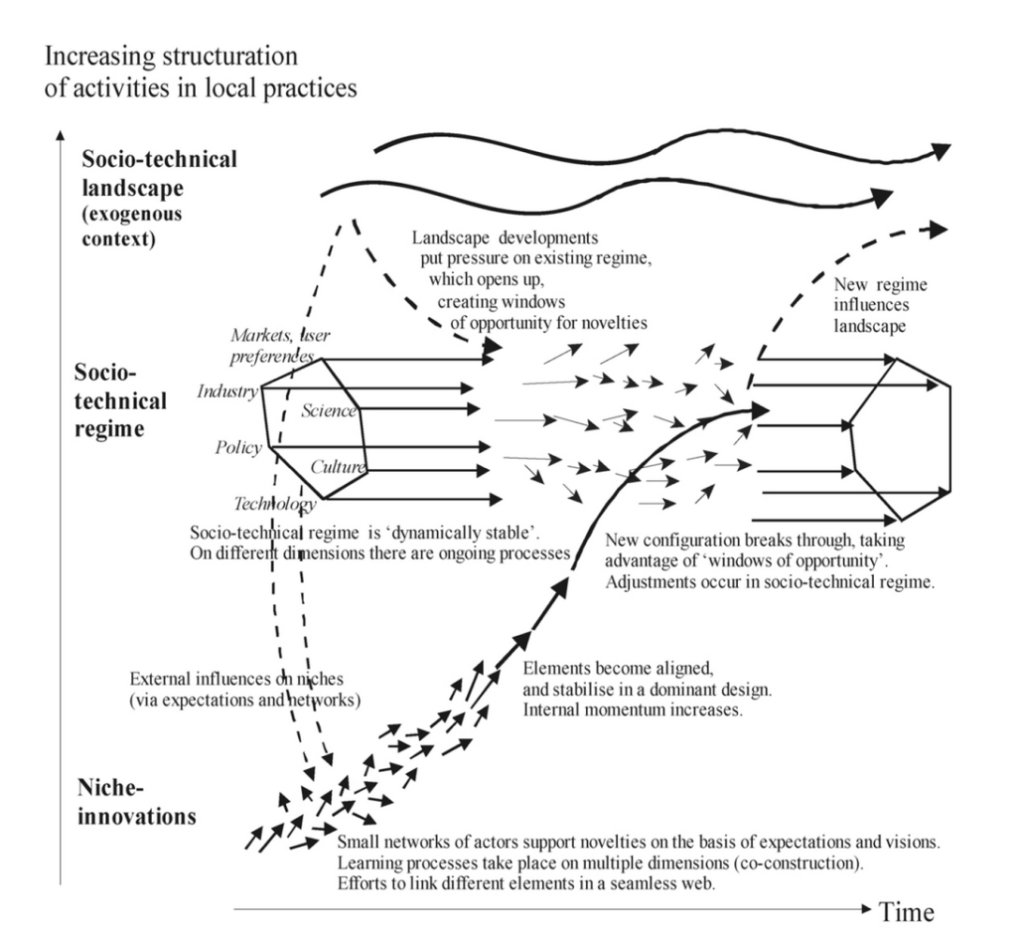
Figure 1 – the Multi-Level Perspective on Socio-technical Transitions (from Geels and Schot 2007)
The three “levels” of the MLP are depicted above, for a systems transition process (that might take 50 years or more on the whole). The business-as-usual “system” is represented by the “socio-technical regime” in the middle. This could be the dominant food system in a country, for example, or its energy system. This “regime” is relatively stable, but experiences “stresses and strains” and is “destabilised” by trends in the “landscape” – which is represented by the top level. These destabilising forces create opportunities for (disruptive) innovation – which has been “hiding” in “niches” at the bottom level – to take hold and change the processes of the regime.
The key point is that for disruptive, or radical, innovation to take hold and change a system, events have to occur across the three levels – pressure from the landscape, which destabilises regimes, allowing for innovators to emerge from their protected niches so they can “hook onto” the regime structures and change business-as-usual. This is a complex and contextual process – it will look different in India compared to Europe or China; food systems transitions may be linked but look different from those in energy systems, etc.
This multi-level perspective explains a lot, once you get used to it. For example, a top Indian ecologist complained (bitterly) to me a couple of years ago that “we scientists have been shouting from the rooftops [about climate change], but nobody has done a damned thing!”. From the MLP, we might say that “scientists shouting from rooftops” might not constitute effective or sufficient landscape pressure to create opportunities for change. (Is there a better way to leverage academic research into landscape pressures for the benefit of society and the world? Why isn’t this happening already? How can we make it happen? Are new types of collaborations needed?..)
The MLP also provides an approach to steer ourselves onto a sustainable development pathway. The UN Sustainable Development Goals (SDGs) are well known, of course. One sometimes hears the opinion that lack of progress on these ambitious goals is “simply a case of missing leadership and poor implementation”. I would like to point out that, as far as I can tell, “achieving the SDGs” involves significantly more complexity than this view allows for, because the SDGs tell you what to aim at, but not how to get there. “How” to get there is contested and heavily context-dependent – and the MLP provides a framework to create, implement and test roadmaps to steer ourselves towards such goals.
If we accept that the MLP (and related systems science approaches) could hold the key to “changing the world” towards “achieving sustainability”, we can ask the interesting question – on what “paradigms” is it based? and how do these differ from those in the “business-as-usual” approach, insofar as these have contributed to the “mess” we are in with climate change, sustainability, etc?
One of the most interesting “paradigm shifts” is the “evolutionary” approach the MLP takes. The theory was synthesised in contemporary form by Frank Geels of the Twente School in Netherlands, by studying how transitions had occurred previously in the modern era, notably the shift from a regime of wind-driven sailing ships to the steam-engine powered era.
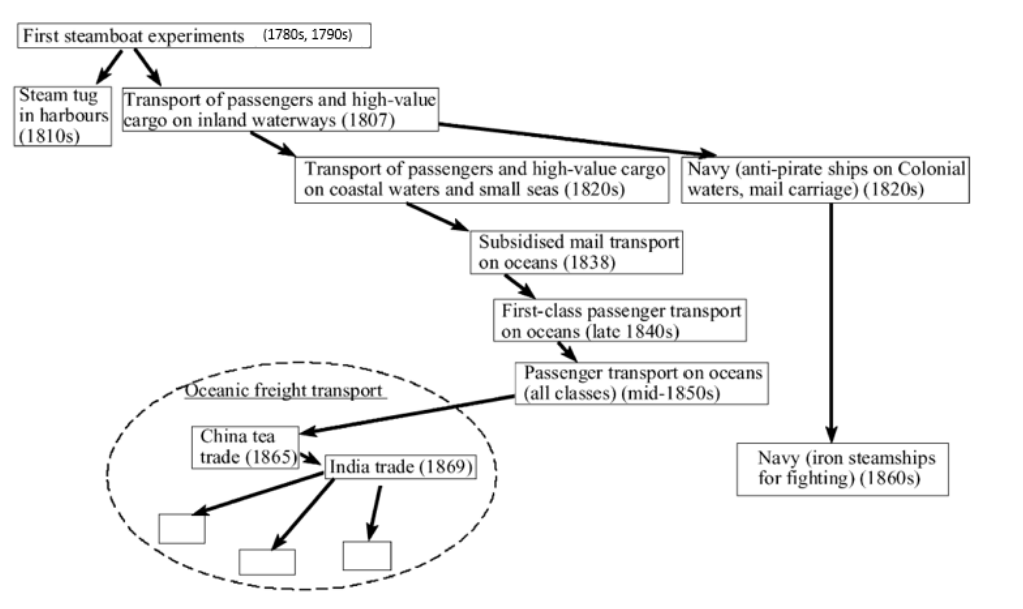
Figure 2 – Niche cumulation in the steamship transition (corrected from Geels 2002)
This transition, which happened over the course of a century, is depicted above. One of the key concepts Geels borrowed from evolutionary biology is that of “niches” and their “accumulation”. When a new species (or gene) emerges in the wild, it doesn’t all of a sudden colonise all existing populations. It goes through a gradual process where it progressively occupies more and more evolutionary “niches” (on the basis of its “fitness” for each micro-environment, etc.) before being eventually “selected” and “retained” by the population at large.
In the context of socio-technical transitions, the evolutionary processes of variation, selection and retention are present in the MLP, as well as niche-cumulation as depicted in Figure 2. Variation – or the creation of novelty – is driven by entrepreneurs and innovators and the logic of competitive capitalism, rather than by random mutations of genetic structure. Selection occurs when an innovation is able to “hook” onto a socio-technical regime – for example, when a new water management system is adopted by a thirsty industry. Retention occurs when the new approach becomes the new “business-as-usual” and is propagated into the future by the regime.
(It’s important to note that the niches are not “waiting out there” but are created by landscape pressures. For example, the construction of the Suez canal, a landscape change, led to the “India trade” niche in 1869 for steamboats.)
The second place where evolutionary paradigms occur in the MLP is in the concept of socio-technical regimes. According to “business-as-usual” economic theory (also referred to as neoclassical economics), markets constantly operate to achieve an “equilibrium” of “forces” of demand and supply. Whenever there is a change in demand, or in supply, the market negotiates a new “equilibrium” point where a “price signal” determines the quantity of production of the particular commodity in question.
This picture is borrowed from the physical sciences, and forms the basis for a lot of the economic policy in the world. Unfortunately, this is not an accurate representation of how individuals and firms actually operate, given the evolutionary history of human beings. A lot of our processing is intuitive, cognitively biassed and governed by “bounded” rationality. In other words, our economic decision making does not resemble the usual assumptions of neoclassical economics (think of a sort of supercomputer with infinite market information and processing power). We do have individual agency, but our actions and processes are often governed by conventions and culture; these allow us to process the complexity of the world within the constraints of our individually limited brainpower.
This “bounded” rationality – which evolution has built into our psychology – is reflected in the “stability” of the socio-technical regimes. In other words, even if a better, more sustainable product is out there – it is not going to be immediately located and snapped up by the system (the marketplace) in the short-term. The regime will change (to a more sustainable one) only when “hardened” cognitive and behavioural “structures” are “stressed” and “destabilised” by events in the landscape. As a practical example – think of energy systems. The war in Ukraine has woken Europe up to the unnerving reality of an imminent energy crisis. This landscape pressure could therefore create accelerating opportunities for cleantech to “emerge from the niches” and “hook onto” destabilised regimes there. Perhaps these will even be “retained” and become the new “business-as-usual”. While the ongoing conflict is a massive humanitarian tragedy, it has undoubtedly disrupted the “usual” routines of the regime, at least as far as energy is concerned.
A key application of the MLP’s evolutionary approach is in developing innovation policy with the explicit intended outcome of a transition to sustainability. The development narrative of a country like India will most likely involve many new products and marketplaces that today’s business-as-usual, with its short term focus, simply doesn’t prioritise. If business-as-usual “undersupplies innovation”, especially in critical sustainability-related fields, then it is up to public and impact funding to “create the niches” where innovations can develop, learn and mature – and power the sustainable systems of the future. How can innovation policy be informed by the MLP to explicitly steer a course towards this future?
The MLP is a “scientific” theory of how systems change happens. However, I believe its applicability will go far beyond academic confines and the classroom. Whether in entrepreneurship, technology, finance, business problem-solving, public policy, governance, community work or activism – an appreciation of systems science like the MLP can help strategise and coordinate action for sustainable development, for a world in flux. We will explore some of these application domains in further articles.
Solvesustain collaboratively researches, designs and develops solutions and models to enable and accelerate sustainable development outcomes. What jumped out at you from this article? I’d love to hear your thoughts and suggestions!
Further reading
Geels, F. W. (2020). Micro-foundations of the multi-level perspective on socio-technical transitions: Developing a multi-dimensional model of agency through crossovers between social constructivism, evolutionary economics and neo-institutional theory. Technological Forecasting and Social Change. https://doi.org/10.1016/j.techfore.2019.119894
Geels, F. W., & Schot, J. (2007). Typology of sociotechnical transition pathways. Research Policy. https://doi.org/10.1016/j.respol.2007.01.003
Geels, F. W. (2002). Technological transitions as evolutionary reconfiguration processes: A multi-level perspective and a case-study. Research Policy. https://doi.org/10.1016/S0048-7333(02)00062-8
Leave a Reply