In the last couple of articles, we motivated the need to look at “sustain-ability” from a “systems” perspective. How can we use methods of science to examine a community’s water system, a city’s transport system, a country’s food system, or even the “world-system”, to understand how, why and in which specific ways unsustainable outcomes are created by these? And use this understanding to develop new systems that will secure sustainability into the foreseeable future?
In this article, we will take these somewhat abstract ideas and examine them through a specific and very interesting example – the Dutch energy transition (DET). The DET is remarkable for the manner in which bottom-up innovation has played a central role; the level to which systems science has been engaged; and the public scrutiny the process has been subjected to by leading scientists.
The “science” on which the DET is based is called the “multi-level perspective on socio-technical transitions” (quite a mouthful, let’s call it MLP for short!). This is an evolving theory that has been developed over the years to understand how change occurs in societies, and has since the early 2000s been applied to the DET. The theory has been deeply researched and strengthened especially by Prof. Frank Geels of the University of Manchester.
Let’s first start with the notion of a “socio-technical system”. In simple words, this might be thought of as “technological systems, and their interconnections, that facilitate societal functions”. Let’s take an example. Coal mines, solar power plants, hydro-power plants, nuclear power stations etc. – these are energy sources. These might be connected via networks of cabling and power transformers to distribute and route power. There may be material transport in the system (shipping oil, for example). There might be markets at various levels to trade energy that are also part of the system. And communication networks, management systems and rules (policies) to ensure that the system functions effectively. The energy system in all its messy complexity should at the end of the day facilitate all the societal needs for energy – for transport, for homes and community needs, to keep the engines of industry productive, etc.
It’s clear that socio-technical systems of the modern world are enormously interlinked and intricate. Sustainability “transitions” (for example, “deep decarbonization” of the energy system) are, therefore, characterised by complexity. As we manage our transitions to sustainability – whether in energy, water or other socio-technical systems – how can we develop processes and techniques that recognise, factor in and even help us thrive through complexity?
In the DET, the MLP provides a framework for “understanding” complexity towards factoring it into an adaptive plan for decarbonization. This approach moves away from both extremes – of purely top down, centralised policy-driven strategies – which have been so ineffective, for example, in halting climate change – and free-market fundamentalism, the belief that unregulated markets will create public good through the power of a magical-sounding “invisible hand”.
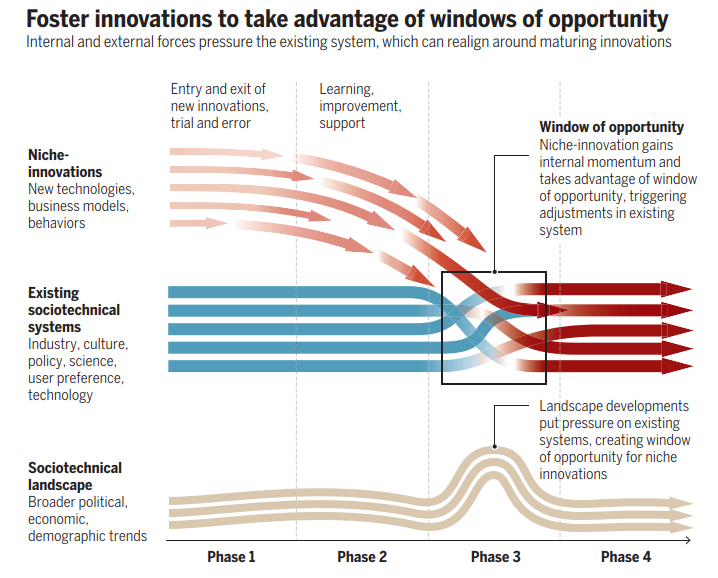
Source: Socio-technical transitions for deep decarbonization
The interesting diagram above illustrates the key aspects of the MLP in understanding systems change. First of all, there is a “landscape” illustrated at the bottom of the above figure. This can be thought of as “analogous” to the actual landscape we see around us – mountains, roads, rivers, buildings, etc. – but in the “socio-technical” world that philosophers place modern man to inhabit. Just like the landscapes around us, this “socio-technical” landscape can have relatively static elements, and dynamism as time progresses. For example, as the call for climate action becomes more strident, the “landscape” itself can change with a steep curve as shown.
On the second level of the MLP exist the “hardened structures” of society. These represent, for example, “business as usual” – the ways in which industries take, make and dispose of products in the systems of consumer capitalism. They can also represent socio-cultural norms – for example, prevailing notions around how many children one should have, or how much one should rightfully consume, or aspirational levels of wealth, etc.
The landscape can change either “suddenly” – as in the example of COVID-19 – or “gradually” – as in the move towards decarbonization by 2050. As the landscape changes, it puts “pressure” on the hardened systems of society. This causes the “dominant way” and “alignment” of these so-called “regimes” to become disturbed. In other words, “the way we have always done it” becomes disturbed or dislodged, and “opportunities for change” present themselves.
Society always has a small subset of enterprising folks who thrive on risk. These entrepreneurs normally live in small “niches” (for example, incubation centres, university labs, innovation hubs etc.) They are usually in the shadows, out of the mainstream, because their models are not yet “stable” or “robust” enough to survive the test of hardened systems in the marketplace. But when dominant regimes are disturbed by landscape changes, they can find their opportunity and their place to create a new, better regime.
An example of this process might play out as follows. There is growing clamour for climate action and increasing calls for decarbonization. Investors feel this landscape pressure keenly, as their role calls for them to balance risk and reward, and climate risk starts to grow more material by the day. Investors start pressuring industries to disclose carbon numbers (for example through platforms like the Carbon Disclosure Project). It starts to become unacceptable for industries not to disclose. More and more of them disclose. With so much data being released, there are concerns of misreporting or misrepresentation. An enterprising entrepreneur recognises this, and builds a solution for verified and validated visibility of carbon emissions, underpinned by technologies like Blockchain and machine-learning.
In the Dutch case, the MLP was used to develop a process of “complex systems based adaptive governance” called transition management. We will further explore such tools, methods and approaches for systems innovation in future articles. In the meantime, I would like to leave you with the following questions:
What do the levels of the MLP look like in the society and systems I live in? Where are the niches? The hardened and dominant “regimes”? Where are landscape changes “putting pressure” on systems? Who has spotted an opportunity-in-the-making, and how might things change over the next few years? How can we form and steer a transition where actors from across society come together to flourish in a complex world?
I look forward to hear your comments, feedback and criticisms!
This article is part of a series on sustainability transitions.
References and further reading
- Geels, F. W., Sovacool, B. K., Schwanen, T., & Sorrell, S. (2017). Sociotechnical transitions for deep decarbonization. Science, 357(6357), 1242–1244. https://doi.org/10.1126/science.aao3760
- Geels, F. W., & Schot, J. (2007). Typology of sociotechnical transition pathways. Research Policy, 36(3), 399–417. https://doi.org/10.1016/j.respol.2007.01.003
Leave a Reply